
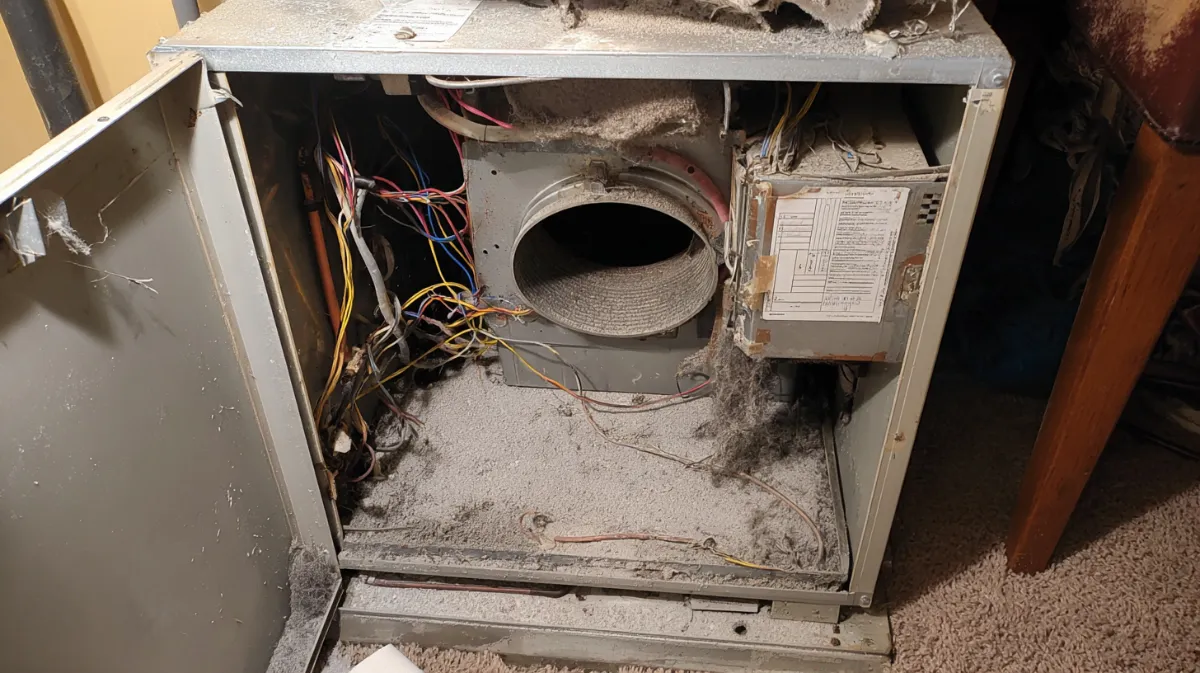
Every bit of air in your house passes through one metal box several times an hour. Inside it, a fan shaped like a hamster wheel pushes air across the heat exchanger in winter and across a cold, wet coil in summer. Dust that gets past the filter sticks to both. The fan blades fill in and move less air. The coil mats over like a clogged radiator and can't shed heat. The system runs longer to do the same job, and in a Medford July with the temperature over 100, that shows up fast. We see it often in older homes around Jacksonville and Talent, where the furnace sits in a crawl space or closet and nobody has opened the cabinet in years.
Here's what follows: how to tell the equipment itself is dirty, what each part does, how we clean it and how to keep it clean. The work is done at the furnace or air handler, and it usually fits into the same visit as a duct cleaning. If the ductwork hasn't been done either, read about our air duct cleaning first.
Signs the Equipment Is Dirty
Weak airflow at every vent, as opposed to one room, points to the blower or coil instead of a single blocked duct. So does an AC that runs constantly on a hot afternoon and never quite catches up. Look for water in the pan or on the floor under the indoor unit, which happens when dust and slime plug the condensate drain. A musty smell in the first minute of cooling usually comes from the coil. In winter, a furnace that starts, runs a few minutes and shuts off may be overheating because it can't move enough air. A filter that's been missing, bent or the wrong size for a while almost guarantees a dirty system.
The Parts That Matter
Three parts do most of the work. The blower wheel is a drum of small curved blades. A layer of dust no thicker than a coat of paint changes the shape of those blades and cuts how much air they move. The evaporator coil is a block of thin aluminum fins that the refrigerant runs through. Air has to pass between the fins, and dust plus condensation turns into a paste that closes the gaps. Below it sit the drain pan and the condensate line, which carry that water outside. The heat exchanger and the cabinet walls round out the list. Cleaning the ducts while leaving these dirty means the first thing clean air meets on every pass is the dirtiest surface in the system.
How We Clean It
Power and gas are shut off first. We open the cabinet, remove the blower assembly and clean the wheel and housing outside, where the mess can't travel. The coil is vacuumed with a soft brush, then treated with a coil cleaner made for the purpose and rinsed so the residue leaves through the drain. We flush the condensate line, clean the pan and vacuum the inside of the cabinet and the return drop. Bent coil fins get combed straight where we can reach them. Everything goes back together, the system is started, and we check airflow and the temperature change across the coil so you have numbers from before and after.
Keeping It Clean
The filter decides almost everything. Check it monthly and replace it when it's gray, which in smoke season can mean every few weeks. A pleated filter rated MERV 8 to 11 is a good fit for most home systems. Going much higher can choke an older blower, so ask before you buy the most expensive one on the shelf. Make sure the filter slot is covered and the filter fits snugly, because air takes the easy path around a loose one. With good filter habits, the blower and coil need cleaning about as often as the ducts do.
Offices and shops have the same equipment on a bigger scale, and our commercial duct cleaning page covers those.
Frequently Asked Questions
No. A tune-up tests the burners, refrigerant charge and electrical parts. A cleaning removes the dust that's built up on the blower, coil and cabinet. The two go together well, and a clean system is easier to service. If the furnace won't light or the AC blows warm, tell us when you call so we know what we're walking into.
Often, yes. That smell is usually growth on a damp, dusty coil or in the drain pan, and cleaning both removes what it feeds on. If the smell comes back within weeks, something is keeping the area wet, like a slow drain or a duct leak pulling in crawl space air, and we'll look for it.
Maybe sooner than you'd think. New systems in new houses often run during construction and pull in drywall dust and sawdust before anyone moves in. If the home was built or remodeled recently, or a filter was ever left out, it's worth a look. If the blower and coil are clean, we'll close it back up and tell you so.